Tree Removal Services in Stratford, NJ
Tree Surgeon & Tree Removal Services in Stratford, NJ
Having trees on your property can be very advantageous, from added property value and visual appeal to oxygen production and erosion protection. However, if a tree is dead or dying, blocking an area set for construction, or its roots are damaging your land and yard structures, it may be time to call in the arborists from Big Timber, the top tree removal service in Stratford, New Jersey.
For over 30 years, Big Timber has been a tree cutting and removal staple in Stratford, NJ, and the surrounding area. Our certified tree specialists are knowledgeable and trained to safely and efficiently take care of the trees on your property, so you can trust that they will always get the job done right!
Contact us today to schedule service or request an estimate!
Interested in Tree Trimming?
Click here!
Tree Removal & Tree Cutting Services
There’s Nothing We Can’t Handle!


Why Tree Removal Services Are Necessary for Your Stratford, NJ Property
The most dangerous aspect of tree care is tree removal and should be used if there is no other viable choice. We are a tree company, so we prefer preserving and caring for trees, but when they need removing, Big Timber is the best in the business.
Here a few reasons to consider having the expert arborists at Big Timber remove trees from your Stratford property:
- Fall Hazards — If a large tree is dying, its structural integrity becomes compromised and is at risk of falling onto houses, cars, and people. Additionally, boughs begin to break off and pose similar hazards to people and property. Weakened trees are dangerous to have on your property and should be taken down immediately.
- Diseases & Infestations — If your tree is affected by a contagious disease like powdery mildew, chlorosis, or white pine blister rust, there is a chance that that disease will kill your tree and spread to other trees, shrubs, and flowers nearby. Similarly, dead trees also attract a whole host of unwelcome and damaging pests, from termites and beetles to aphids and rats. These pests tend to move from tree to tree and from tree to house, so there may be uninvited guests in your home after long.
- Eye Sores — Dead or dying trees are simply unattractive. The bark color turns sickly, leaves no longer grow on the branches, and they begin to lean. It may be prudent to remove those trees and plant new ones in their places to give your property a better look.

Best in the Tree Cutting & Tree Removal Business
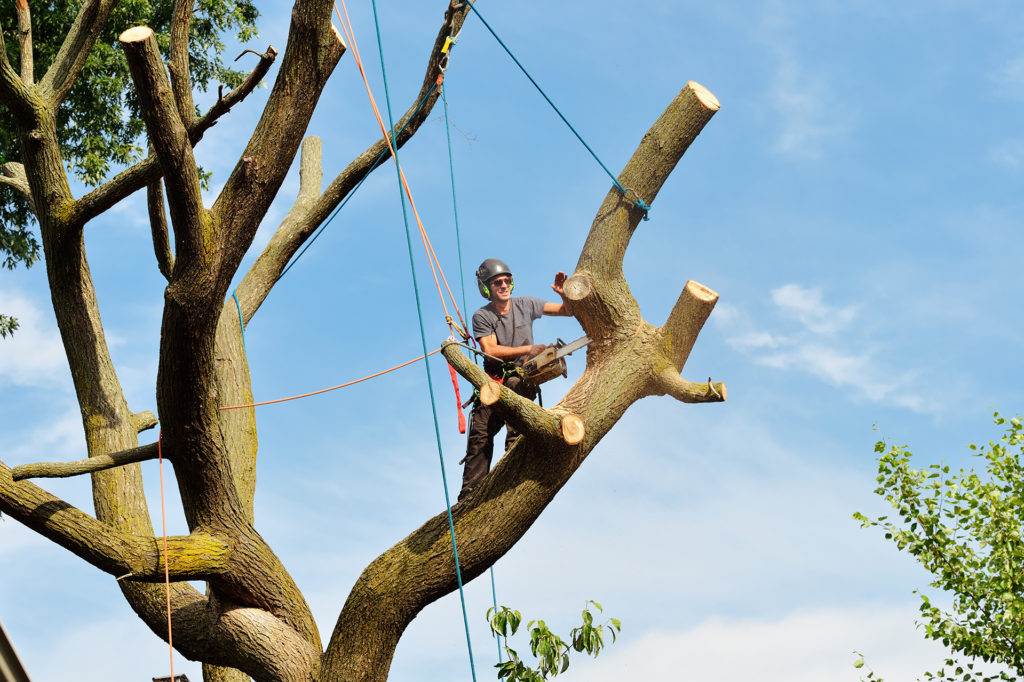
Big Timber employs specialists who are appropriately licensed and trained to work with environmental sustainability in mind. Our expert climbers, trimmers, and cutters use only the most efficient equipment and seek to reduce property and wildlife habitat damage while providing exceptional services to our Stratford, NJ residents. We are also committed to customer satisfaction, so feel free to ask our arborists any questions. They will be happy to explain their processes, share their professional opinions, and notify you if there are any issues.
If you need a tree removed from your Stratford property, call Big Timber today. We provide the best tree care services in the area and look forward to helping you make your property safer and more beautiful. Call our technicians for a free “no obligation” estimate for all tree removal, trimming, stump removal, and storm damage clean-up services in and around Stratford, NJ. Schedule your appointment today!

Emergency Tree Removal Services in Stratford, NJ
Big Timber is always available when you need them most. Need a tree removed after a major storm in Stratford, NJ? Our emergency tree removal specialists have you covered.

Make the Most out of Your Stratford, NJ Property with Our Tree Removal Services
The tree removal specialists at Big Timber are licensed and insured. With more than 25 years of experience, we're ready to take on any tree removal in Stratford, NJ!

Tree Removal Services in Stratford, NJ
Big Timber's tree technicians are trained to handle tree removals efficiently and safely. If you or your neighbors in Stratford need a professional tree removal company, Big Timber is just a call away for any of your arboreal needs!
Stratford, NJ Tree Surgeon Services
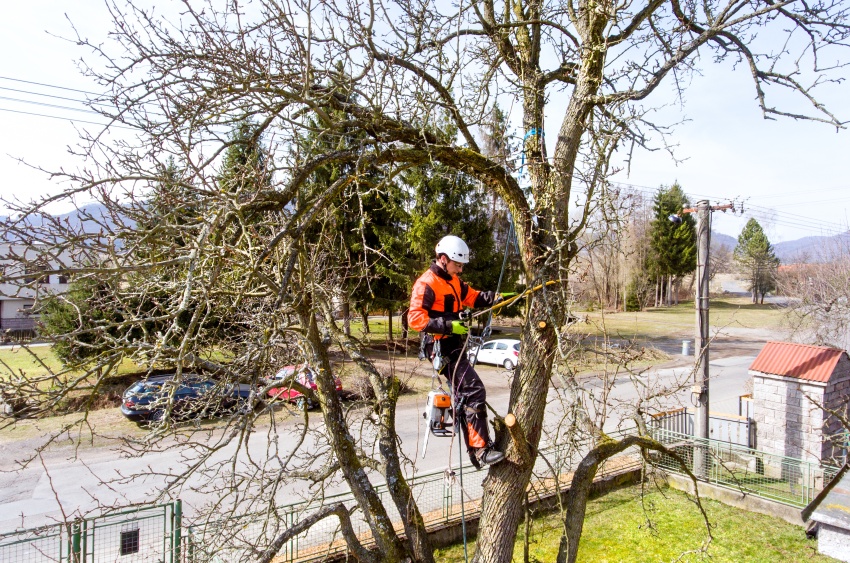
Big Timber will work with you in removing any problematic trees on your Stratford, NJ yard or property. Our skilled tree surgeons can handle any task in tree removal and professional tree care.
The Vine on Your Tree
Stratford is a compact Camden County borough of around a square and a half mile, with a medical campus at its centre and small residential lots around it. On lots this size, fence lines and property boundaries do most of the work — and fence lines are where vines get into trees.
This is one of the most common things people ask us about and one of the few tree topics nobody writes about honestly. So: what is climbing your tree, does it matter, and what should you do?
English ivy
The most common climber on trees around here, and the answer to whether it is harmful is more nuanced than either camp claims. Ivy is not a parasite — it does not feed on the tree, and it climbs by small gripping rootlets rather than boring in.
What it does do is accumulate. It adds substantial weight, and because it is evergreen it holds snow and ice and presents sail area all winter, when a bare tree would not. It climbs into the crown and competes for light. And it covers the trunk completely, which means nobody — including us — can see the cracks, cavities, and fungal brackets that would tell you the tree is failing.
How to know itDark green, glossy, three to five lobed leaves, evergreen, growing in a dense mat flat against the bark.
Poison ivy
Frequently mistaken for something harmless when it is climbing, because most people only know it as a low plant. On a trunk it becomes a thick woody vine, and it is the single most important one to identify correctly before anybody touches it.
How to know itLeaves of three, and on a tree trunk a distinctly hairy vine — covered in fine aerial rootlets that make it look furry or fuzzy. That hairy appearance is the giveaway, and it is still poison ivy in winter with no leaves on it at all.
Virginia creeper
Native, comparatively benign, and constantly confused with poison ivy. It climbs by tendrils with small adhesive pads rather than hairy rootlets, and it is genuinely one of the better autumn colours in the region. Heavy growth can still shade a crown, but it is not the problem the others are.
How to know itFive leaflets radiating from one point, not three. The vine is not hairy.
Oriental bittersweet and wisteria
The genuinely destructive ones, and they work by a completely different mechanism. Rather than climbing flat against the bark, these twine around the trunk and limbs, and as both the vine and the tree thicken, the vine constricts. It girdles the tree in a visible spiral and eventually kills it.
Wisteria in particular is extraordinarily strong and will crush a limb. Both are invasive, both spread readily, and both should come off.
How to know itA woody vine wrapped in a spiral around the trunk, frequently with a visible groove or deformation in the bark where it has bitten in.
Never burn poison ivy, and never put it through a chipper
The oil that causes the reaction is present in every part of the plant — leaves, stems, roots, and bare winter vines — and it does not break down when the plant dies. Burning it carries the oil in the smoke, and inhaling that smoke can cause a severe reaction in the airway and lungs. This is a genuine medical emergency, not an irritation, and it happens every year to people clearing brush.
The same applies to chipping it, which aerosolises it. If poison ivy is on your property and you are clearing, it needs handling separately and disposing of, not burning and not shredding. Tell us it is there — we would much rather know before the crew starts than after.
How to take a vine off a tree properly
- Do not pull it down. This is the instinct and it is wrong. A mature ivy mat grips hard, and hauling it off tears bark away with it and can pull down deadwood you did not know was up there. It also showers you with whatever is living in it.
- Cut the vine at ground level, then again at a comfortable height — around chest height — and remove that section entirely so there is a clear gap.
- Leave the upper growth to die in place. Severed from its roots it will brown off over several months and gradually loosen and fall on its own, without taking bark with it. It looks untidy for a season. That is the correct trade.
- Deal with the roots. Cutting the stem alone means it regrows, so the base needs excavating or treating. This is the step most people skip and the reason the vine is back in two years.
- Clear a ring around the trunk and keep it clear — a few feet of vine-free ground around the base makes reinvasion much easier to spot and stop.
The Real Reason We Want the Ivy Off
Beyond the weight and the winter sail area, there is a practical reason that matters more to us than it does to the tree: we cannot inspect what we cannot see.
A trunk under a dense ivy mat could have a substantial cavity, a vertical crack, or a bracket fungus at the base, and none of it is visible. Every so often we clear ivy off a trunk and find a tree that should have come down years ago. If you have a large tree fully covered near a house, getting the trunk exposed is worth doing simply so somebody can look at it.
After the Tree Is Gone: The Ground It Leaves Behind
The other question we get after every removal, and it deserves a straight answer. The bare patch where a tree stood is not ordinary ground, and there are reasons grass struggles there.
Grinding chips in the soil
If the stump was ground and the chips backfilled, that patch is now heavily loaded with decomposing wood, which ties up nitrogen as it breaks down. Grass seeded into it comes up thin and yellow. Removing the chips and bringing in topsoil solves it; leaving them means waiting a few years.
Ongoing settling
The root system is still down there and it decays over several years, so the ground continues to sink gradually. Expect to top the area up with soil more than once. This is normal and not a sign anything was done badly.
Compaction from the work
Equipment on the ground compresses it, and compacted soil drains poorly and resists rooting. Loosening the area before seeding makes a considerable difference and is easy to skip.
Sudden full sun
Ground that spent decades in shade is now exposed all day. Shade-tolerant grass already established there will struggle, and the soil dries much faster than it used to. Reseed with something suited to sun rather than assuming what was there will carry on.
If it was a black walnut
Worth knowing, because it catches people out. Black walnut produces a compound that suppresses many other plants — tomatoes, potatoes, azaleas, rhododendrons, and blueberries among them. It persists in the soil and in the decaying roots for years after the tree is gone. If you had a walnut and your new planting is failing for no apparent reason, that is very likely why.
Planting a new tree there
Entirely possible, but say so at the estimate. A standard grind leaves a shelf of wood and chips a few inches down that a new tree will sulk in for years. We grind deeper and clear more chip out when we know something is going back in.
Tree Removal in Stratford, NJ
Large Tree Removal
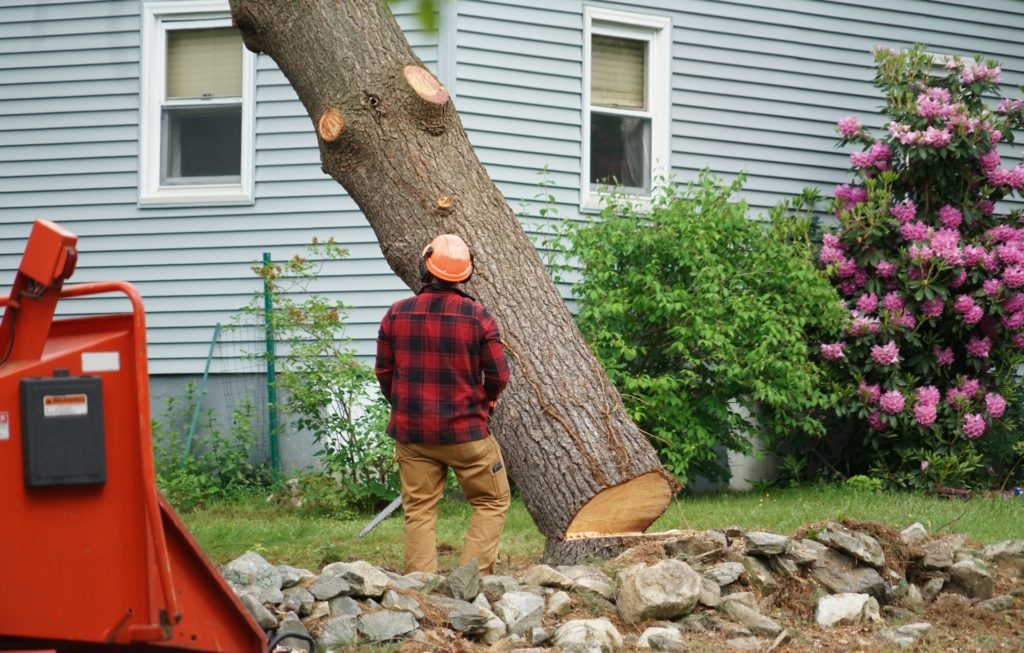
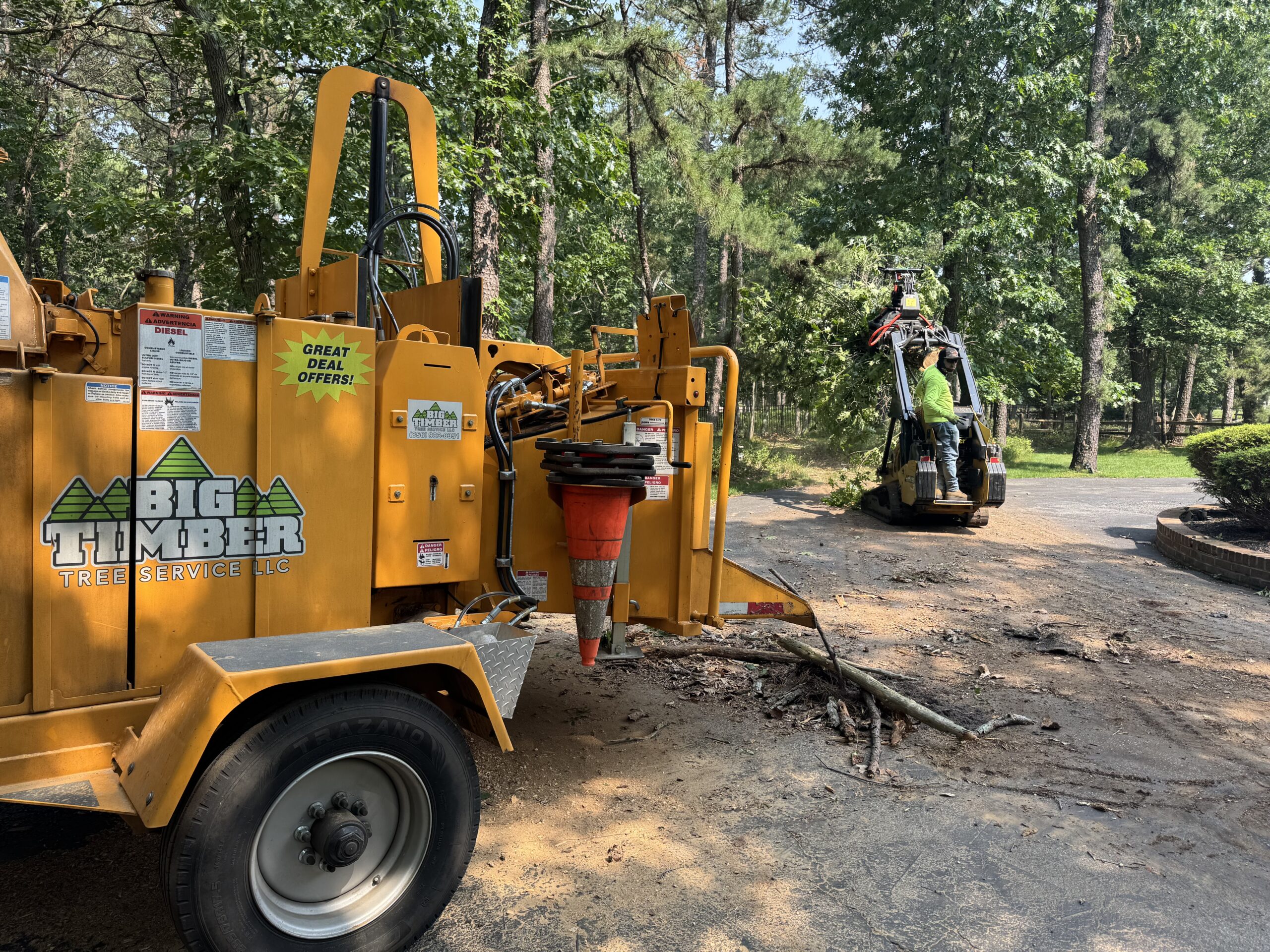
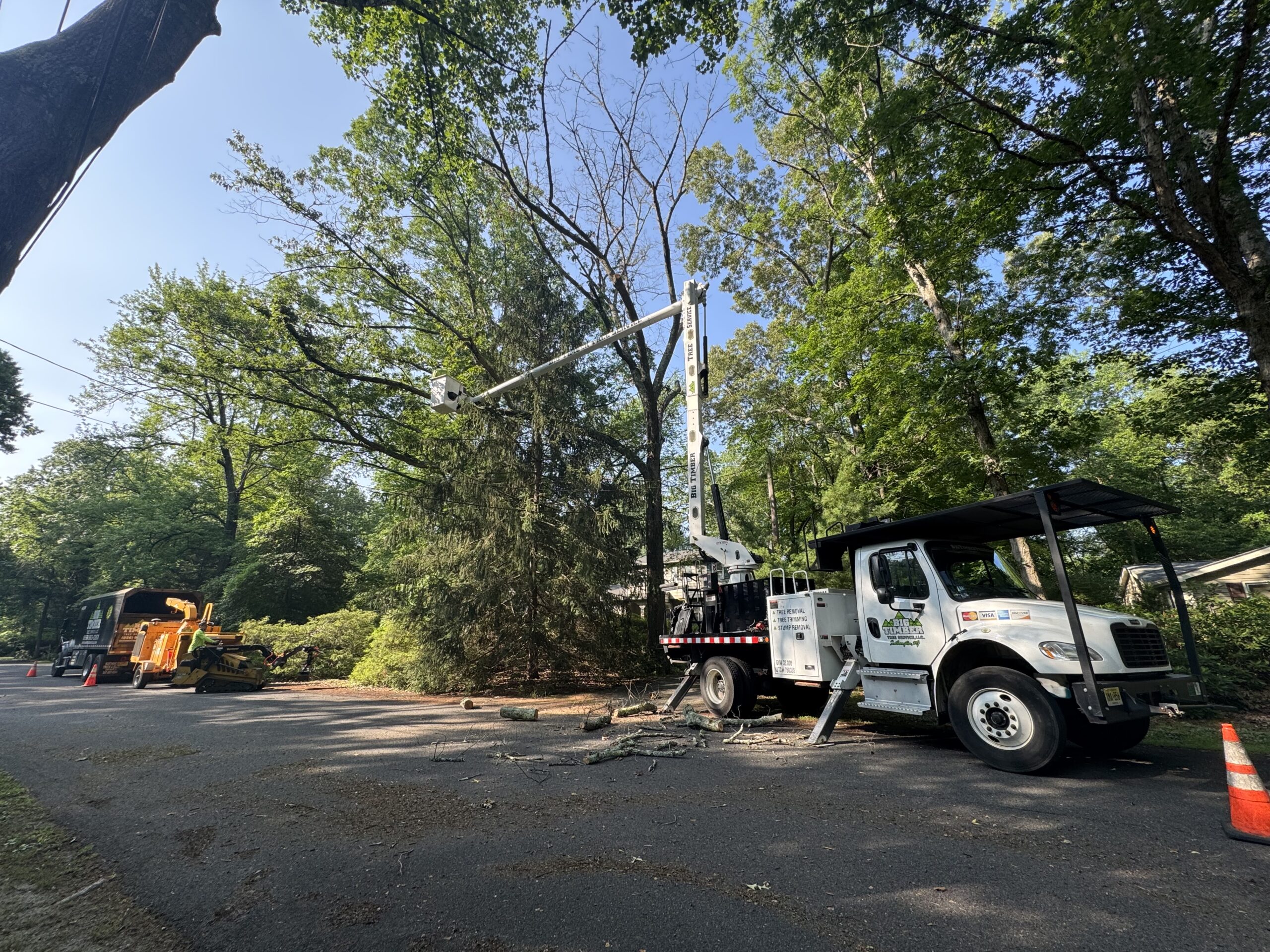
Stratford lots are compact with houses close, so removals are section work — rigged and lowered piece by piece rather than felled. Where the street allows a bucket truck, that keeps equipment off the property and reduces the compaction described above.
Dead Tree Removal
The emerald ash borer has worked through Camden County ash and dead ash goes brittle from the top down. Two seasons standing dead makes it unsafe to climb, so it gets a bucket truck or a crane rather than a climber on spurs.
Institutional and Commercial
Stratford has a substantial medical and campus presence, and that work is scheduled differently — around access routes that cannot be blocked, with written surveys for budgeting and certificates of insurance in advance. We are open 24 hours, so overnight and weekend windows are normal.
Emergency and Storm Damage Tree Service, 24 Hours a Day
Big Timber runs emergency tree service around the clock, seven days a week. Storm damage tree removal and fallen tree removal in Stratford frequently starts with clearing a street or driveway before anyone can reach the damage.
One point that connects to the first half of this page: an ivy-covered tree is a genuinely higher winter risk than a bare one, because the evergreen mat holds snow and ice and catches wind through the months when the tree has no leaves. If you have large ivy-covered trees near the house, clearing them is winter preparation rather than tidying.
Insurance and Utility Lines
We photograph damage as we work and deal directly with insurance adjusters, providing whatever the claim requires. On lots this close together a tree coming off one property and landing on the next is routine, and the documentation is what the claim turns on.
Service drops to a house are routine work. A primary distribution line gets coordinated with the utility before anyone cuts — we do not work around live conductors. If a tree is on a structure, across a road, or into a wire, call (856) 288-1793 rather than filling out a form.
Tree Trimming and Pruning in Stratford, NJ
Deadwood removal, roof and gutter clearance, canopy lifting over driveways and walks, service drop clearance, and weight reduction on long horizontal leaders. Vine clearance from trunks and crowns falls into the same visit and is usually inexpensive alongside other work.
Booked for the dormant season wherever it is not urgent — and specifically for oaks, which should be pruned November through March. See our tree trimming service or the Stratford tree trimming page.
Stumps, Bamboo, and Firewood
Stump Grinding
Stump grinding four to six inches below grade, deeper where something is going back in. Tell us what the ground is for and whether you want the chips taken away — it changes the outcome considerably, as above.
Running Bamboo
The other thing that arrives along a fence line and refuses to leave. Rhizomes travel under fences, walks, and driveways, and cutting the canes accomplishes nothing — our bamboo removal service excavates it properly.
Seasoned Firewood
Our removals produce a great deal of hardwood, seasoned and sold as delivered firewood — cut, split, stacked, and dried until it actually burns rather than green wood sold as seasoned.
Tree Care Services in Stratford, NJ
- Vine removal from trunks and crowns, including poison ivy handled safely
- Tree trimming, pruning, and deadwood removal
- Tree removal and tree cutting — where preservation is genuinely not viable
- Trunk inspection on trees currently hidden under ivy
- Emergency and storm damage response, 24 hours a day
- Stump grinding and stump removal
- Running bamboo removal
- Brush clearing and overgrowth removal
- Seasoned firewood delivery
We serve Stratford and the surrounding Camden County communities, including Somerdale, Lindenwold, Laurel Springs, Hi-Nella, and Clementon.
Stratford Tree and Vine Questions
Is English ivy bad for my tree?
Not as a parasite — it does not feed on the tree. But it adds substantial weight, and being evergreen it holds snow and ice and catches wind all winter when the tree is bare. It also completely hides the trunk, so cracks, cavities, and fungal brackets cannot be seen. On a large tree near a house, that last point is the strongest argument for taking it off.
How do I tell poison ivy from Virginia creeper on a tree trunk?
Count the leaflets and look at the vine. Poison ivy has three leaflets and forms a distinctly hairy vine on the trunk, covered in fine aerial rootlets. Virginia creeper has five leaflets and climbs by tendrils with small pads, not hairy rootlets. The hairy vine is poison ivy even in winter with no leaves on it.
Can I burn poison ivy I have cleared?
No, and this matters more than anything else on this page. The oil is present in every part of the plant including dead and leafless vines, and burning carries it in the smoke. Inhaling that smoke can cause a severe reaction in the airway and lungs. Do not chip it either, which aerosolises it. It needs separate handling and disposal.
Should I pull the ivy down off my tree?
No. A mature ivy mat grips hard and pulling it off tears bark away and can bring down deadwood. Cut it at ground level and again at chest height, remove that section so there is a clear gap, and leave the upper growth to die and loosen on its own over a few months. Then deal with the roots, or it simply regrows.
Why won't grass grow where my tree used to be?
Usually decomposing grinding chips in the soil tying up nitrogen, plus compaction from equipment and the ground being in full sun for the first time in decades. Removing the chips and bringing in topsoil generally sorts it. If the tree was a black walnut, that is a different matter — walnut suppresses many plants and the effect persists in the soil and decaying roots for years.
Licensed, Insured, and Reluctant to Remove Trees
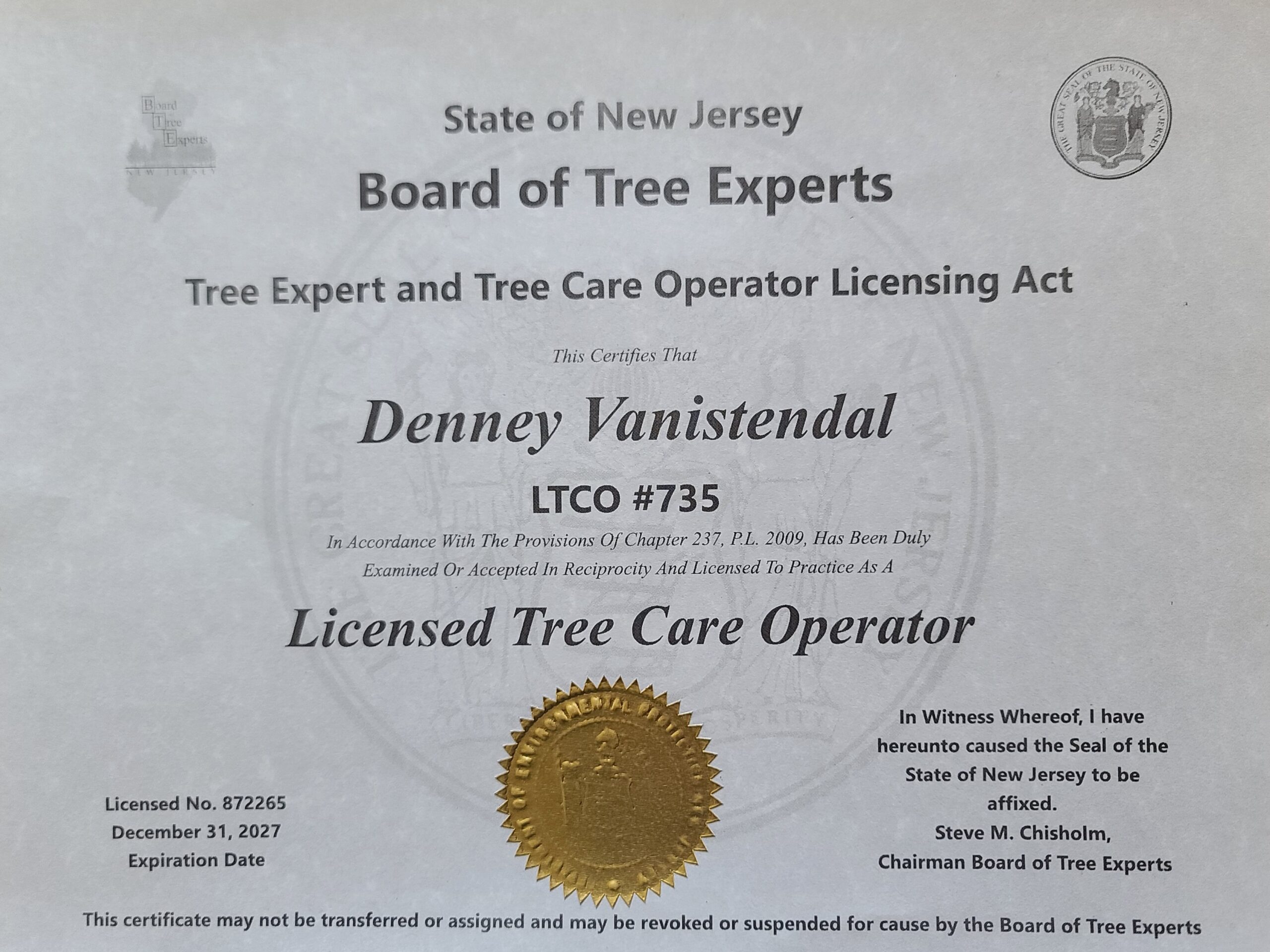
New Jersey law requires a Licensed Tree Care Operator registration for any company performing tree care for compensation. Big Timber holds LTCO 735, and our work is directed by a New Jersey Licensed Tree Expert — the state's highest tree-care credential, covering tree biology, species identification, diagnosis of pests and disease, pruning standards, and safe removal.
This page says elsewhere that removal is the most dangerous part of tree care and should be a last resort, and we mean it. Clearing a vine, exposing a trunk so it can actually be inspected, and pruning a tree properly are all cheaper than a removal and better outcomes. We also carry NJ Home Improvement Contractor License #13VH05439500, general liability, and workers' compensation, and we have worked South Jersey since 1989.
Free, no-obligation estimates in Stratford, NJ — including vine clearance and trunk inspection.
Call (856) 288-1793