Tree Removal Services in Hi-Nella, NJ
Hi-Nella, NJ Quality Tree Removal & Tree Cutting Services
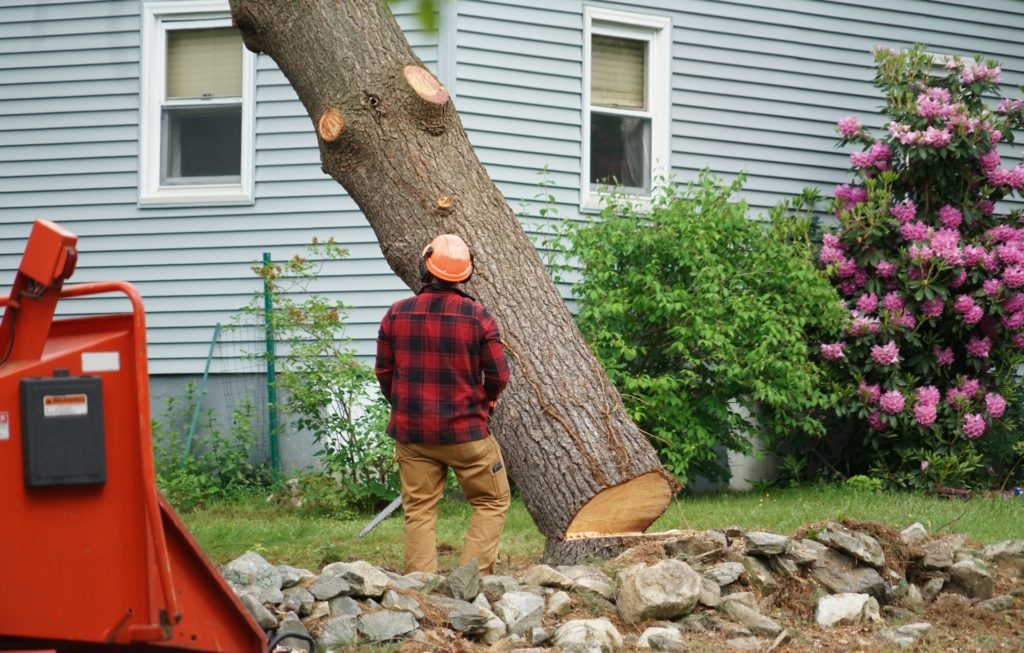
If left alone, the same illness can and will grow to and attack other trees and plants nearby, so you must intervene as soon as possible. If you reside in Hi-Nella, NJ, and you have a hazardous or seriously sick tree that requires tree removal services, you should have it removed as soon as possible.
Do you think it's a smart idea to do your own tree removal? Consider it again. DIY can be useful at times, but not when it comes to tree removal. You will spend a lot more time and possibly get the wrong tools. In this case, you will just make the situation more difficult. Hiring a reputable tree removal company in Hi-Nella, NJ can save you both time and money. Making mistakes with your tree pruning costs much outweighs the savings of doing the task yourself.
Tree removal services can go a long way toward keeping your Hi-Nella house secure. Did you realize that overgrown roots can erode the foundation of your home? The roots that develop beneath your property, road, and other objects that restrict its movement might cause damage. You could have a root growing into your sewage lines and be completely unaware of it. Trees can cause more difficulties than you believe, so keep a watch out for any unusual occurrences. In these cases, tree removal services may be required.
Unsafe trees in Hi-Nella, NJ endanger your family and your property. Don't put your home or family at risk; contact us right away. Trees enhance our houses and the surroundings; nonetheless, they require special care; having unhealthy trees around might endanger you and your family.
Contact us today to schedule service or request an estimate!
Call Today For Free Estimate!
(856) 288-1793
Tree Removal & Tree Cutting Services
There’s Nothing We Can’t Handle!


Tree Removal Company in the Hi-Nella Area
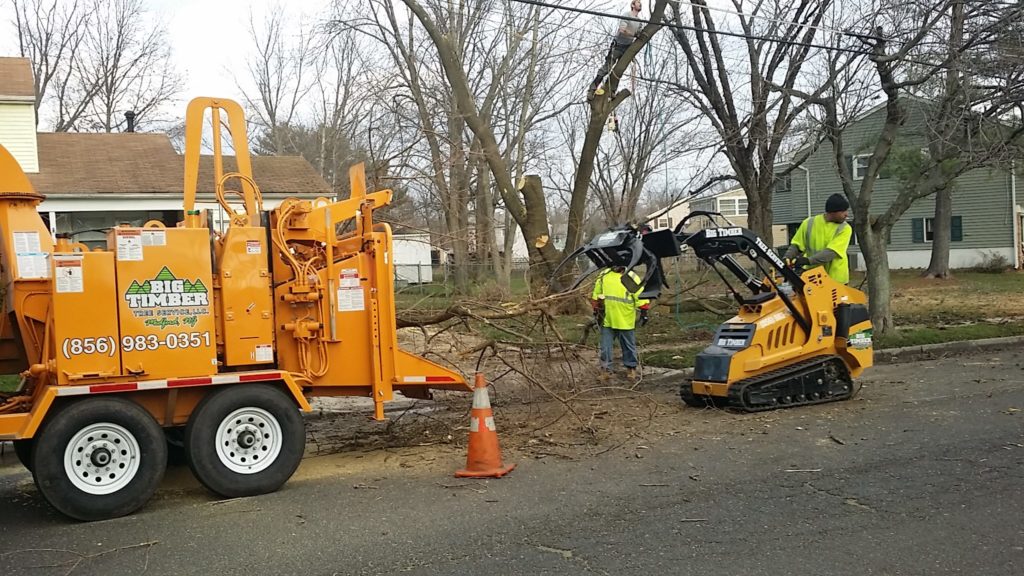
You may save time and money by hiring a reputable tree service. If you have a dangerous or badly diseased tree in Hi-Nella, NJ, you will need tree removal services as soon as possible. Unsafe trees endanger your family and property. Removing trees, especially huge ones, will necessitate the use of the proper instruments. If you are unfamiliar with how to use these tools, you may damage yourself or others. Trust the Hi-Nella, NJ tree removal professionals that have been doing this for years! You can handle a lot of things yourself, but tree removal services are not one of them, in our opinion. Aside from the exorbitant expense of the technology, it requires genuine expertise to use it appropriately.
Overgrown or sick trees in Hi-Nella, NJ, tend to shed more leaves and debris in your yard. Having a tree removed improves the overall appearance of your environment while also preventing pests from nesting in the dry barks and accumulated falling leaves. Nobody wants an old dying tree to be an eyesore, therefore get rid of it! Don't put your house or family at risk; if you live in the Hi-Nella, NJ region, contact us right now. Trust the professionals who have been doing this for years!
Tree Service in Hi-Nella, NJ
Hi-Nella is one of the smallest municipalities in New Jersey — roughly a third of a square mile of Camden County, tucked between Stratford, Somerdale, Lindenwold, and Gloucester Township. And unlike almost anywhere else we work, most of it is not single-family houses. It is condominium and apartment communities.
That changes who we are actually talking to. In most towns the person who calls owns the tree. Here the person who calls is frequently a property manager or a board member, the tree is on common ground, and the decision involves a budget, a vote, and a set of governing documents. Different problem, different process.
Who Is Actually Responsible for the Tree?
This is the first question on almost every multi-family job, and it is answered by your association's governing documents rather than by any general rule. But the categories are consistent, and knowing them makes the conversation much faster.
Category
Typically means
Common element
Grounds the association maintains for everyone — entrance plantings, buffer strips, parking islands, lawns between buildings. Trees here are almost always the association's responsibility, funded from the operating budget or reserves, and the board decides.
Limited common element
Areas assigned to specific units but still owned in common — a patio, a small rear yard, a deck surround. This is where responsibility gets genuinely ambiguous, and where the master deed needs reading before anyone commits to spending.
Unit owner responsibility
In some communities, planting within an assigned area belongs to the owner even though the land does not. Worth establishing early, because it determines who receives the estimate.
Neighbouring property
A tree on adjacent land overhanging the community, or vice versa. Common in a borough this compact, and it needs documenting rather than assuming.
What we do about it. We will not guess. On a multi-family property we identify each tree's location precisely in the estimate, so a board or manager can match it against the governing documents before authorising anything. If the answer turns out to be that a tree is a unit owner's responsibility, that is better established before the work than after the invoice.
Budgets, Reserves, and Why Timing Matters
Associations do not spend the way homeowners do. Work needs to be in a budget, and budgets are set on a cycle. A board that discovers in July that four trees need removing has a considerably harder problem than one that had a written survey in hand the previous autumn.
So the most useful thing we provide a board is not a price for today's problem — it is a written survey of every tree on the property with a condition and a rough timeframe, so the work can be phased across budget years instead of arriving as a special assessment. That is the document boards actually need and rarely have.
Comparing Tree Bids as a Board
Boards are usually required to obtain multiple bids, and tree work is genuinely hard to compare because three companies will quietly propose three different jobs. Here is what to insist every bid states, so you are comparing like with like.
Ask every bidder to specify
- Which trees, identified unambiguously. By location and species, not "the trees at the rear." Tagging or a marked site plan removes any later argument.
- The method for each. Felled, sectioned and rigged, bucket truck, or crane. This is where most of the price difference actually sits.
- Whether cleanup and haulaway is included, and whether that covers chips as well as logs.
- Stump grinding as a separate line, with a depth. "Stumps ground" without a depth is not a specification.
- Traffic and pedestrian control where work is near parking, walkways, or entrances. On an occupied property this is not optional and it costs money.
- Resident notification — who is responsible for it and how far in advance.
- Current certificates of insurance naming the association, plus the New Jersey Licensed Tree Care Operator number. Verify it; do not just accept it.
- What happens if weather moves the date, since it will.
A bid that is substantially cheaper than the others has usually left something out of that list, and on an occupied residential property the thing left out is frequently the traffic control or the insurance.
Working on an Occupied Property
Parking is the real constraint
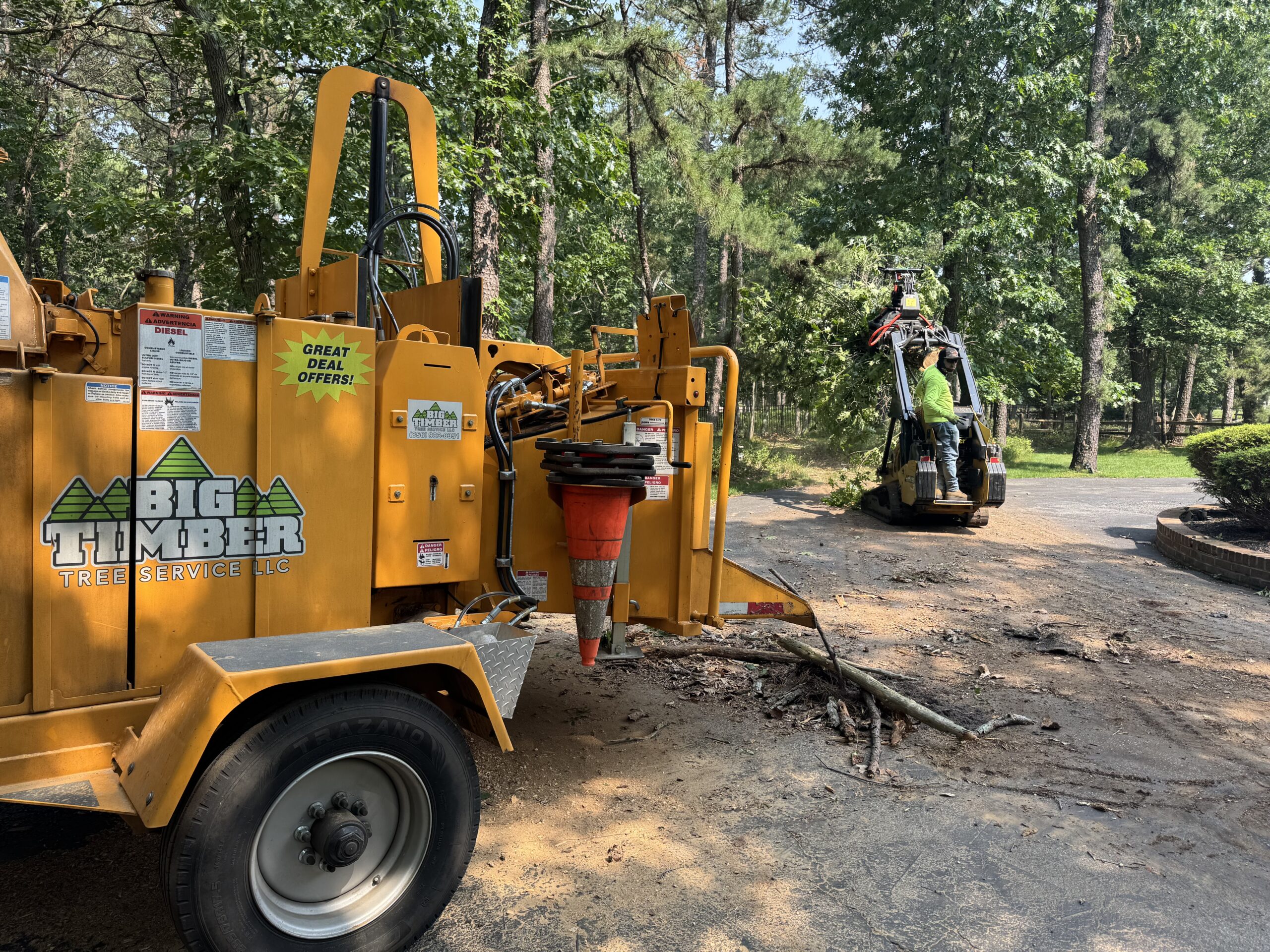
In a condominium community the drop zone is almost always somebody's parking space. Cars need moving, which means notice, which means the schedule has to be firm enough to give notice against. We would rather agree a date two weeks out and hold it than promise Thursday and slide.
Noise and residents at home
Apartment and condo communities have people home during the day — shift workers, retirees, young children. A chipper running outside a bedroom window at seven in the morning generates complaints the board then has to field. We will work to whatever window the property prefers.
Access and pavement loading
Interior drives and parking areas in older complexes are not always built for a loaded truck or a crane outrigger. We look at the route and the setup points before quoting, because cracked asphalt is a repair bill that turns a cheap tree job into an expensive one.
Emergency Response at a Multi-Family Property
Big Timber runs emergency tree service around the clock, seven days a week. On a community property, though, the delay is rarely us — it is authorisation.
Sort this out before you need it
At two in the morning with a tree across the entrance drive, nobody wants to be working out who can approve emergency spending. Boards that have agreed in advance who holds that authority, and up to what figure, get their access cleared hours sooner than boards that have not.
We are glad to be on file as a vendor with the certificates already lodged, so that when it happens the only question is where to send the crew.
Documentation for the claim
We photograph damage as we work and deal directly with adjusters. On an association property that documentation frequently has to satisfy an insurer, a board, and sometimes an individual unit owner whose vehicle or patio was involved. We provide whatever each of them needs.
If a tree is on a building, across a drive, or into a wire, call (856) 288-1793 rather than filling out a form. Service drops are routine; a primary line gets coordinated with the utility first.
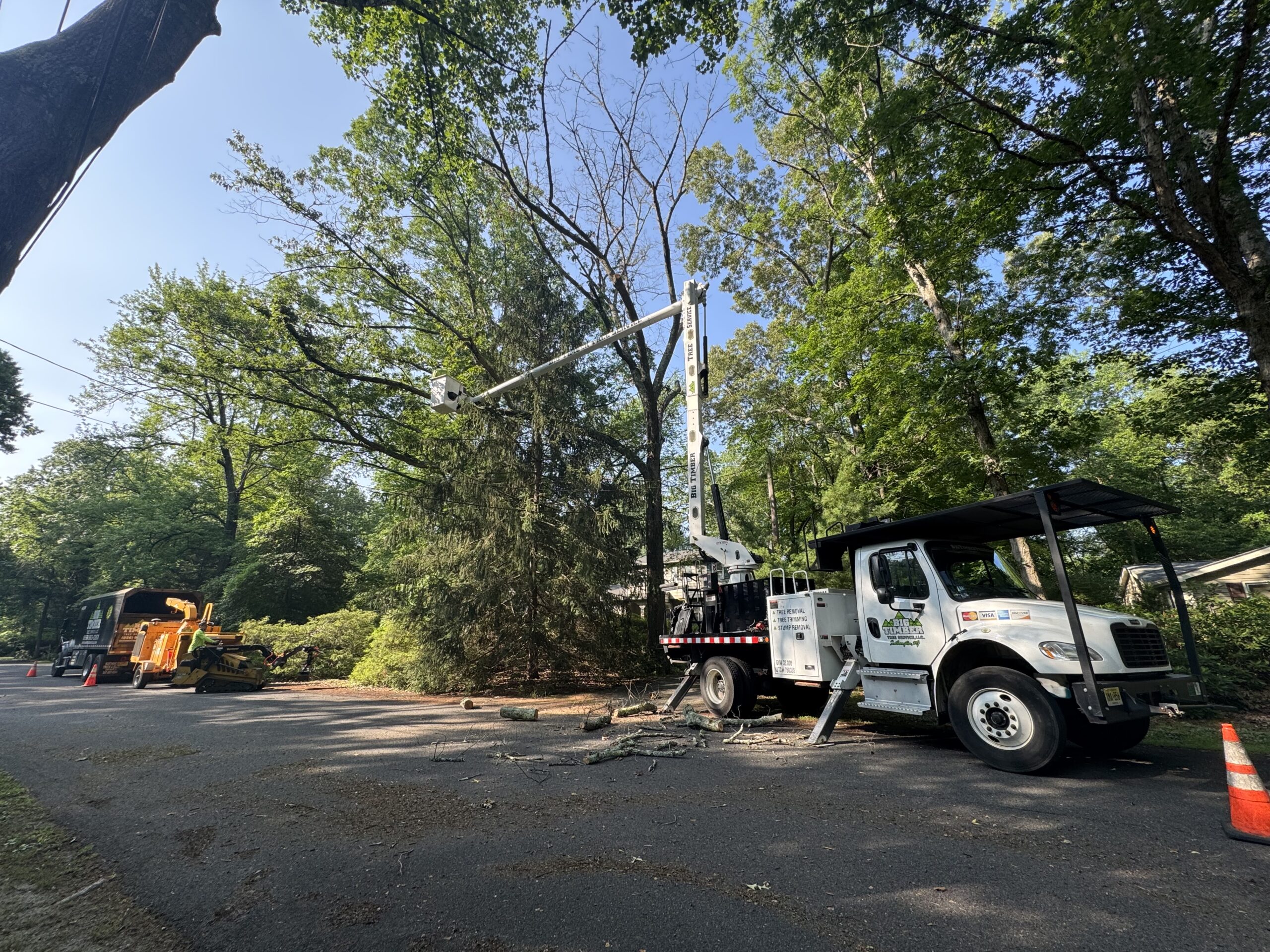
Scheduled Pruning Beats Emergency Response
On common ground, pruning is the line item that reduces every other line item. Clearing deadwood over walkways and parking, lifting canopy off buildings and gutters, clearing utility service drops, and reducing weight on long leaders over the drives.
It also does something specific for a board: it demonstrates that a known risk was addressed on a schedule. Where a limb over a resident walkway is concerned, that record matters. See our tree trimming and pruning service.
Homeowners in Hi-Nella
The borough does have single-family properties, and none of the above applies to them — you own the tree, you decide, and we quote it like any other residential job. Removal, pruning, deadwood, storm damage, and stump grinding, with cleanup included and the permitting handled where the borough requires it.
Large Tree Removal
Lots here are compact, so removals are section work — rigged and lowered rather than felled. Where the street allows a bucket truck, that keeps equipment off the property entirely.
Dead Tree Removal
The emerald ash borer has worked through Camden County ash and dead ash goes brittle from the top down. Two seasons standing dead makes it unsafe to climb, so it gets a bucket or a crane.
Stump Grinding
Four to six inches below grade, deeper if something is going back in. Our Hi-Nella stump grinding page has more detail.
Bamboo and Firewood
Running Bamboo
A recurring problem in compact communities, and one that crosses boundaries by design — rhizomes travel under fences, walks, and parking areas. Cutting the canes accomplishes nothing; it has to be excavated, with a barrier where an adjacent property is still infested. Our bamboo removal service handles it, and on association property it is worth resolving before it becomes a dispute between the community and a neighbour.
Seasoned Firewood
Our removals produce a great deal of hardwood, seasoned and sold as delivered firewood — cut, split, stacked, and dried until it actually burns rather than green wood sold as seasoned.
Tree Care Services in Hi-Nella, NJ
- Written tree surveys for condominium and apartment communities, phased across budget years
- Scheduled pruning and deadwood removal on common grounds
- Tree removal and tree cutting, residential and association
- Emergency and storm damage response, 24 hours a day
- Vendor onboarding with certificates of insurance on file in advance
- Stump grinding and stump removal
- Running bamboo removal
- Seasoned firewood delivery
We serve Hi-Nella and the surrounding Camden County communities, including Stratford, Somerdale, Lindenwold, Clementon, and Gloucester Township.
Hi-Nella Tree Service Questions
Who is responsible for a tree on condominium common ground?
Usually the association, but it depends on your governing documents rather than on any general rule — particularly for limited common elements like patios and assigned rear areas, where it is genuinely ambiguous. We identify each tree's exact location in the estimate so a board or manager can check it against the master deed before authorising work.
Can you provide a survey our board can budget from?
Yes, and it is the most useful thing we do for an association. A written survey of every tree on the property with condition and a rough timeframe lets work be phased across budget years rather than arriving as a special assessment. Most boards do not have this and it is why tree spending tends to feel like a series of emergencies.
How do we compare three tree bids fairly?
Require every bidder to state which trees by location, the method for each, whether haulaway of chips and logs is included, stump grinding depth as a separate line, traffic and pedestrian control, who notifies residents, and current insurance certificates naming the association. A bid materially cheaper than the others has usually omitted one of those.
Can you work around residents and parking?
Yes, and it is most of the planning on an occupied property. The drop zone is normally somebody's parking space, so we agree a firm date far enough ahead for notice to go out, and we will work to whatever hours the community prefers rather than starting the chipper at seven.
What should our board do before an emergency happens?
Agree in advance who can authorise emergency spending and up to what figure, and get a vendor on file with insurance certificates already lodged. The delay at two in the morning is almost never the tree company — it is working out who can say yes.
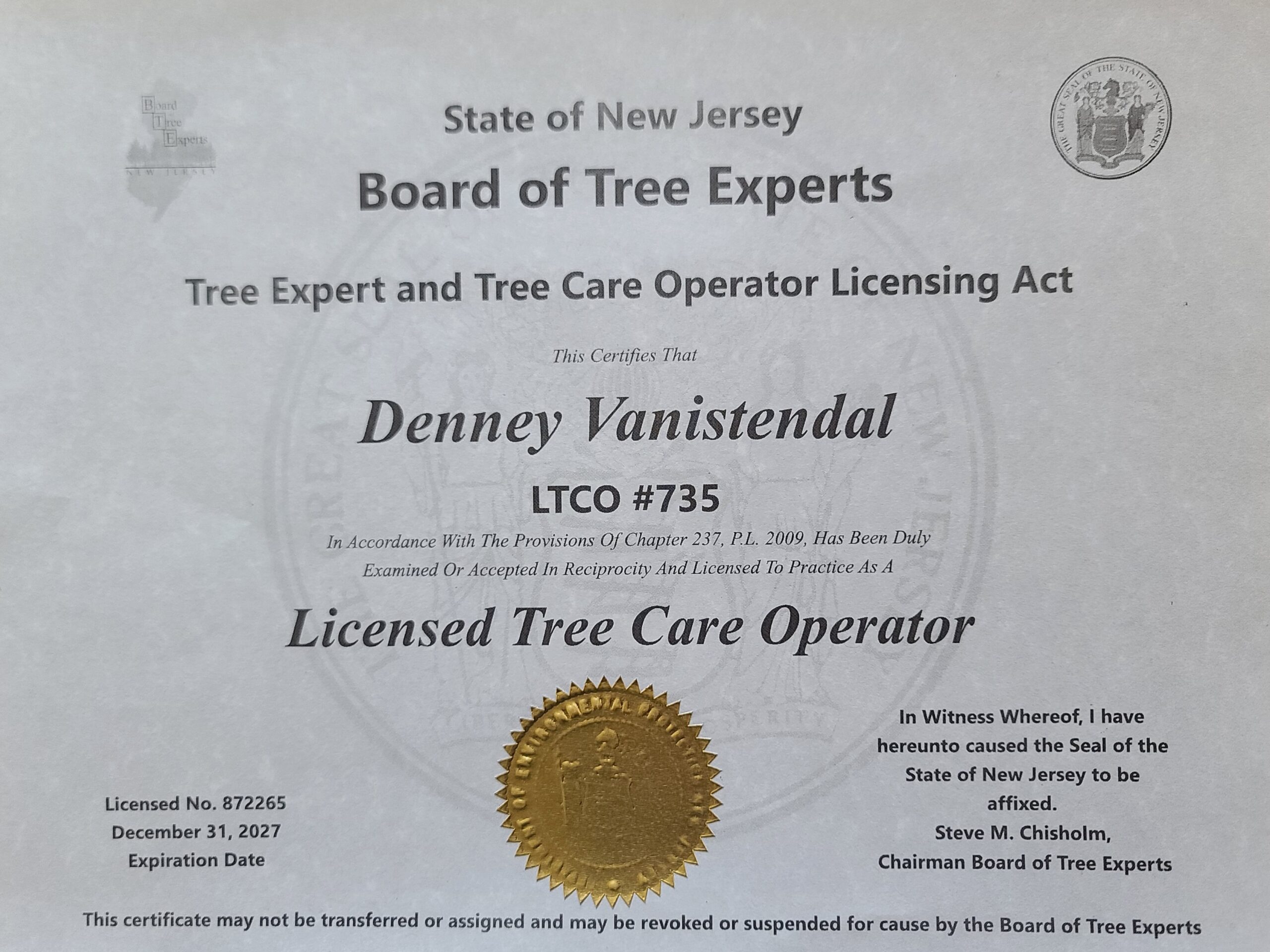
Licensed, Insured, and Set Up for Association Work
New Jersey law requires a Licensed Tree Care Operator registration for any company performing tree care for compensation. Big Timber holds LTCO 735, and our work is directed by a New Jersey Licensed Tree Expert — the state's highest tree-care credential, covering tree biology, identification, diagnosis of pests and disease, pruning standards, and safe removal.
On association property, insurance is a procurement requirement rather than a courtesy. We carry general liability and workers' compensation plus NJ Home Improvement Contractor License #13VH05439500, and we can supply certificates naming the association in advance so a board is not chasing paperwork mid-emergency. We have worked South Jersey since 1989.
Free tree surveys and estimates for Hi-Nella homeowners, boards, and property managers.
Call (856) 288-1793