Tree Removal Services in Gloucester Township, NJ
Gloucester Township, NJ Quality Tree Removal & Tree Cutting Services
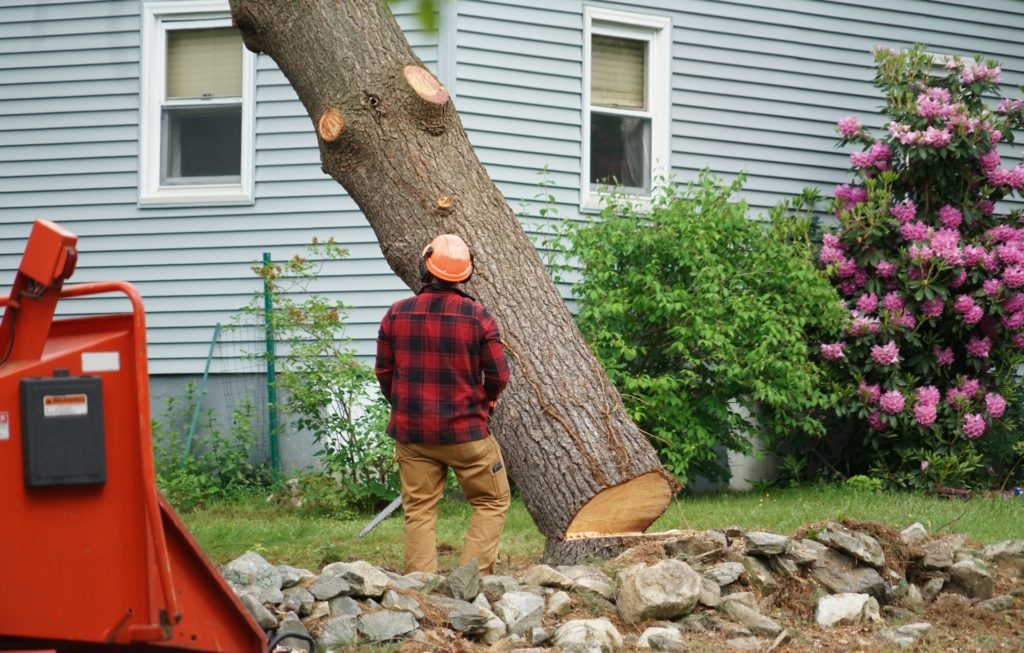
If you live in Gloucester Township, NJ, and you have a dangerous or seriously sick tree that needs to be removed, you should do it immediately.
Do you believe it's a smart idea to do tree removal on your own? Reconsider. When it comes to tree removal, DIY can be useful at times. You'll spend a lot more time on it, and you might end up with the wrong tools. You will simply make the process more complex in this situation. You can save time and money on tree removal by using a trustworthy firm in Gloucester Township, NJ. Making mistakes with your tree pruning will cost you considerably more than saving money by doing it yourself.
In terms of keeping your Gloucester Township house safe, tree removal services are essential. Did you realize that excessive root growth might cause your house's foundation to deteriorate? The roots that develop beneath your home, driveway, and other structures that get in the way of its passage can cause damage to your home, driveway, and other structures. You may be completely unaware that a root has grown into your sewage lines. Trees can create more issues than you might imagine, so keep an eye out for anything unusual. Tree removal services could be required in certain scenarios.
Trees that are dangerous to your family and property in Gloucester Township, NJ are a danger. Don't put your family or your home at risk; contact us right now.
Contact us today to schedule service or request an estimate!
Call Today For Free Estimate!
(856) 288-1793
Tree Removal & Tree Cutting Services
There’s Nothing We Can’t Handle!


Tree Removal Company in the Gloucester Township Area
If you live in Gloucester Township, NJ, and you have a dangerous or seriously sick tree, you should call for tree removal services right once. Trees that aren't safe are a danger to your family and property. To get the task done, you'll need the correct instruments to remove trees, especially huge ones. If you are unfamiliar with how to use these instruments, you risk injuring yourself or others. Trust the Gloucester Township, NJ tree removal pros that have been doing this for years! You can accomplish a lot of things on your own, but tree removal is not one of them, in our opinion. Aside from the exorbitant expense of the equipment, proper use necessitates significant knowledge.
Overgrown or sick trees in Gloucester Township, NJ tend to shed more leaves and debris in your yard. Removing a tree will improve the overall appearance of your property while also preventing bug infestations in the dry bark and piled falling leaves. Get rid of that old dying tree that's been standing there like a sore thumb! If you live in the Gloucester Township, NJ region, don't put your house or family at risk; contact us today.
Tree Service Across Gloucester Township, NJ
Gloucester Township covers around twenty-three square miles of Camden County and takes in Blackwood, Glendora, Chews Landing, Erial, Grenloch, Blenheim, Hilltop, and part of Sicklerville. It is one of the largest municipalities in the county, and it is drained by Big Timber Creek and its tributaries — which, given the name on our trucks, we have always taken as a good omen.
It is also the one township on our service list where the ground changes underneath you. The Pinelands boundary runs through Gloucester Township, and that means trees on either side of the same municipality fail in two entirely different ways.
Heavier soil, so trees break
Inner Coastal Plain ground here holds moisture and gives roots something to grip. Trees root deeper, hold well at the base, and rarely uproot. Instead the failure moves up into the structure: split unions between co-dominant stems, cracks in the main trunk, and large limbs shed out of otherwise healthy-looking crowns.
The practical consequence is that after a storm the dangerous tree is frequently the one still standing perfectly upright. A maple with a fresh crack at a major union looks sound from the street and is not.
Pinelands sand, so trees tip
Sandy, fast-draining ground holds almost nothing. Pitch pine and white oak spread wide, shallow root plates rather than anchoring deep. Saturate that sand with a day of rain, put a strong gust on it, and a tree that looked entirely healthy in June comes over at the root in August.
Failures here tend to be complete — whole trees rather than broken trunks — which means more trees on structures and more complete losses rather than repairable damage.
Why this matters when someone assesses your tree. On the northwest side we spend most of the inspection looking up — at unions, at cracks, at branch architecture. On the southeast side we spend it looking down, at the root flare and the soil around the base. A full green canopy tells you almost nothing about anchorage in sand, and a sound root plate tells you nothing about a cracked union thirty feet up. A company applying the same checklist across the whole township is missing something in one half of it.
One More Reason Location Matters Here
The southeastern portion of the township sits inside the Pinelands Area, which can carry permitting requirements on tree removal and land disturbance beyond the township's own ordinance. The northwestern portion does not.
So two neighbours a few miles apart in the same municipality can face genuinely different paperwork for the same job. We check what applies to your specific parcel before work is scheduled rather than assuming, and we handle the permitting as part of the job.
Formal Tree Risk Assessment
Most of what we are asked for is a price. Occasionally what someone actually needs is a document — a written assessment of a specific tree by a qualified professional, stating what is wrong with it and how likely it is to fail. That is a different product from an estimate, and it is worth knowing it exists.
What is the target?
A tree is not hazardous in the abstract. It is hazardous relative to what is beneath it. The same declining oak is a low concern over an unused back corner and a serious one over a child's bedroom or a driveway where cars park all day. Assessment starts with what would be hit, and how often anything is actually there.
How likely is failure?
Not whether the tree could fail — anything could. How likely it is within a defined period, based on what is physically observable: decay, cavities, cracks, root condition, lean and whether it has changed, the proportion of crown that is dead, and species-specific weaknesses.
How likely is impact?
A tree can fail and hit nothing. Direction of lean, prevailing wind, the height of the tree relative to the distance to the target, and what would intercept it on the way down all bear on this. It is the step most people skip.
What are the consequences?
A limb through a shed roof and a limb through a conservatory are not the same event. Consequence severity is what turns the first three findings into a recommendation with a timeframe attached — do it now, do it this year, monitor it, or leave it alone.
When a written assessment is worth paying for
- A neighbour dispute. A written finding from a Licensed Tree Expert that a specific tree is dead or structurally unsound carries weight that a phone conversation does not.
- An insurance claim, before or after. If a tree was visibly dead before it fell, that can affect a claim. Documentation dated before the storm is worth considerably more than a recollection afterwards.
- Buying or selling a house. A large tree close to the structure is a question a buyer will raise. Having the answer in writing is better than negotiating in the dark.
- A condominium or homeowners association. Boards cannot act on a verbal opinion. They need something minuted, budgeted, and defensible.
- A municipal notice. If the township has told you to address a tree, a written assessment establishes what is actually required.
- Before construction. Identifying which trees will survive the work — and which need protecting — costs a fraction of losing them three years later.
Tree Removal in Gloucester Township, NJ
Large Tree Removal
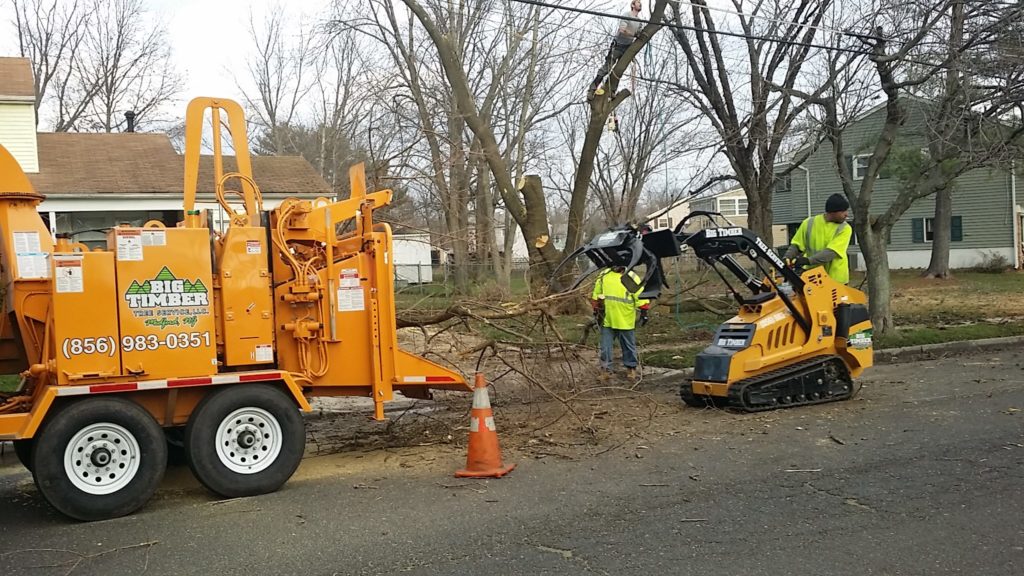
The township runs from tight older lots to properties with real room. Where there is space, a mature tree can be felled conventionally, which is faster and cheaper. Where there is not, it comes down rigged and lowered in sections with the drop zone controlled at every stage.
Dead Tree Removal
Southern pine beetle has worked through Pinelands pine on the southeast side and the emerald ash borer through ash across the whole township. Both leave standing dead trees that go brittle and cannot be climbed safely — those get a bucket truck or a crane.
Cleanup and Stumps
Every removal we quote includes hauling limbs, logs, and chips. Stump grinding is a separate line item, four to six inches below grade, deeper if you intend to plant something there. Quoted up front.
Emergency and Storm Damage Tree Service, 24 Hours a Day
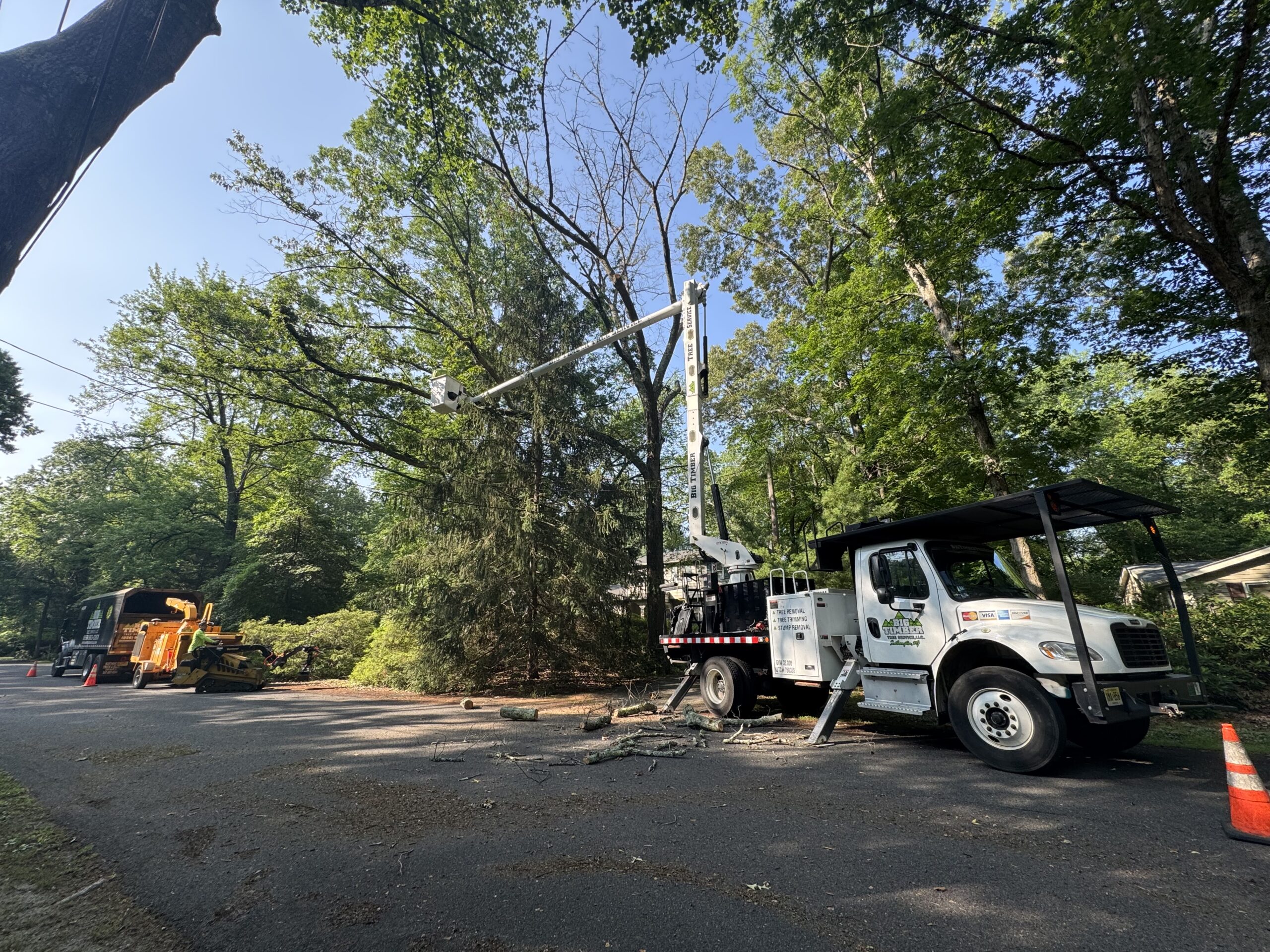
Big Timber runs emergency tree service around the clock, seven days a week. Storm damage tree removal and fallen tree removal in Gloucester Township frequently starts with clearing a road or a driveway before anyone can reach the damage.
Because of the soil split, one storm produces two different sets of calls across this township — uprooted trees on the Erial and Sicklerville side, broken limbs and cracked unions around Blackwood and Glendora. Worth knowing when you are describing the problem on the phone, because it changes what equipment we bring.
Insurance and Utility Lines
We photograph damage as we work and deal directly with insurance adjusters, providing whatever the claim requires. Where a tree came off a neighbouring property, that documentation is what the claim turns on.
Service drops to a house are routine work. A primary distribution line gets coordinated with the utility before anyone cuts — we do not work around live conductors. If a tree is on a structure, across a road, or into a wire, call (856) 288-1793 rather than filling out a form.
Tree Trimming and Pruning in Gloucester Township, NJ
Pruning is what prevents most of the emergency calls, and given the two failure modes above it does slightly different work on either side of the township. On the heavier northwest side it is about weight — reducing the long horizontal leaders and split-prone unions that break. On the sandy southeast side it is about deadwood, because pines hold dead limbs for years and then shed them without warning.
Either way it costs a fraction of a removal and postpones the removal by decades. See our tree trimming and pruning service.
Bamboo, Clearing, and Firewood
Running Bamboo
One of our most common calls in this township. Rhizomes travel under fences, walks, and driveways, and cutting the canes accomplishes nothing at all — it has to be excavated, with a barrier where a neighbouring property is still infested. Our bamboo removal service handles it, and there is a dedicated Gloucester Township bamboo removal page.
Lot Clearing and Mowing
Selective clearing through to full land clearing and excavation, plus brush mowing and field mowing on vacant parcels and overgrown ground. Priced on area and condition rather than per tree — tell us how long since the last cut.
Seasoned Firewood
Our removals produce a great deal of hardwood, seasoned and sold as delivered firewood — cut, split, stacked, and dried until it actually burns rather than green wood sold as seasoned.
Tree Care Services in Gloucester Township, NJ
- Written tree risk assessment by a NJ Licensed Tree Expert
- Tree removal and tree cutting — dead, hazardous, or structurally failing
- Tree trimming, pruning, and deadwood removal
- Emergency and storm damage response, 24 hours a day
- Stump grinding and stump removal
- Running bamboo removal by excavation
- Lot clearing and land clearing
- Brush and field mowing
- Seasoned firewood delivery
We serve every community in Gloucester Township, including Blackwood, Glendora, Sicklerville, Chews Landing, Erial, and Grenloch, along with neighbouring Runnemede and Winslow Township.
Gloucester Township Tree Service Questions
Is Gloucester Township in Gloucester County?
No — Gloucester Township is in Camden County, which catches out a great many people. It includes Blackwood, Glendora, Chews Landing, Erial, Grenloch, and part of Sicklerville. We serve both counties, so it makes no practical difference to getting the work done.
Why do my trees fall over when my cousin's across town just lose branches?
Soil. The Pinelands boundary runs through this township. On the sandy southeast side roots spread wide and shallow and trees tip at the root once the ground is saturated. On the heavier northwest side trees hold at the base and fail higher up in cracked unions and shed limbs instead. Same storm, two different outcomes, one municipality.
Do I need a Pinelands permit for tree removal?
It depends which part of the township you are in. The southeastern portion sits inside the Pinelands Area and can carry requirements beyond the township ordinance; the northwestern portion does not. We check what applies to your specific parcel before scheduling and handle the permitting.
What is a tree risk assessment and do I need one?
It is a written assessment of a specific tree by a qualified professional, covering what is beneath the tree, how likely it is to fail, how likely it is to hit that target, and how serious the consequences would be. Most people do not need one. You probably do if there is a neighbour dispute, an insurance question, a property sale, an association board, a municipal notice, or construction planned near the tree.
Can tree roots damage my house foundation?
Rarely in the way people fear. Roots do not push through sound concrete — they exploit cracks and voids that already exist, and they can worsen drainage problems around a foundation. The far more common damage is to sidewalks, driveway aprons, sewer laterals, and septic fields, which sit shallower and are easier to get into.
Why a Written Assessment Needs a Licence Behind It
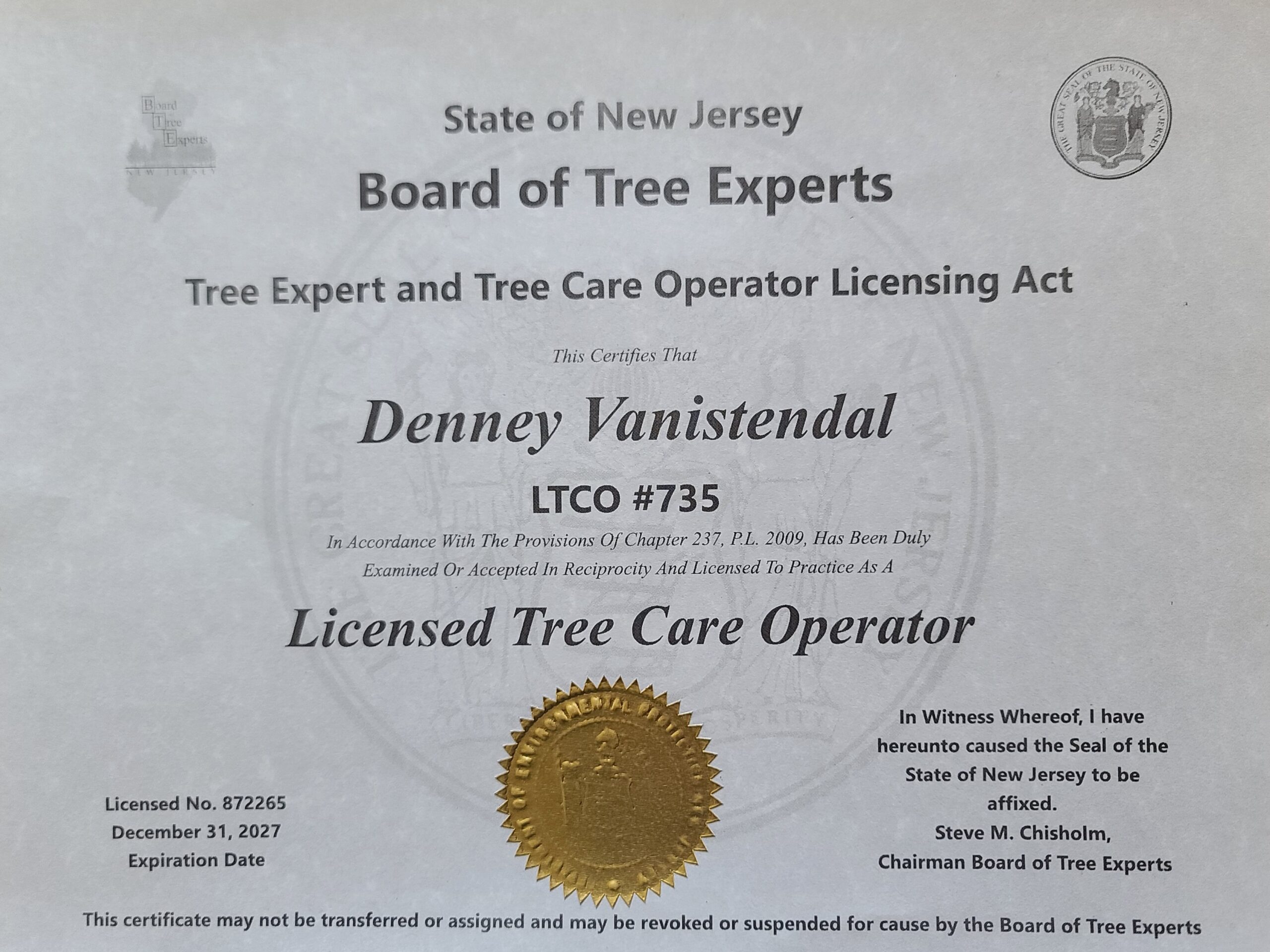
New Jersey law requires a Licensed Tree Care Operator registration for any company performing tree care for compensation. Big Timber holds LTCO 735, and our work is directed by a New Jersey Licensed Tree Expert — the state's highest tree-care credential, covering tree biology, species identification, diagnosis of pests and disease, pruning standards, and safe removal.
That credential is what makes a written assessment worth having. An unlicensed contractor's opinion that a tree is dangerous carries no weight with an insurer, an association board, or a neighbour's attorney. A finding from a Licensed Tree Expert does. We also carry NJ Home Improvement Contractor License #13VH05439500, general liability, and workers' compensation, and we have worked South Jersey since 1989.
Free, no-obligation estimates on tree removal throughout Gloucester Township, NJ.
Call (856) 288-1793